


Prof. Catenaccio and members of her Greek 203 class on Plato’s Symposium brave the blizzard for end-of-term festivities at Pizzeria Toro. read more about The Triumph of Philosophy »

On Friday, December 7 students from all four sections of Latin 101 competed in a Certamen (contest) to test their Latin knowledge and review for the final exam. PhD candidate Courtney Monahan took the lead in organizing and running the event, using Trinity College "Student Speakeasy" funding for a proposal she and PhD candidate David Stifler wrote. All four Latin 101 instructors (Monahan, Stifler, PhD candidate Laura Camp, and supervisor Dr. Rex Crews) had their sections represented. The winning team were the ironically-… read more about Latin Certamen Provides Fun Outlet on Last Day of Class »

The Classics Department has a new Spring offering: CLST 348 Classical Greek Archaeology: Archaic to Classical with Dr. Kyle Jazwa. CLST 348 will be held on Monday and Friday, 3:05-4:20. In it, you will study the material culture of Greece in the Archaic and Classical periods (ca. 700-323 BCE). From the Parthenon to the Persian War to Perikles, all the great P’s will be covered (and other letters, as well)! read more about Newly Added Course for Spring 2019 »

Coins are not simply the raw material of catalogue compilers and a source of chronological information! Students learned during their visit to the Nasher Museum with Prof. Jiménez how to analyze coins from an archaeological perspective, and the foundations of coin identification. They also discussed how ancient coins provide evidence on ancient commodification, exchange and consumption patterns. Students reading the legend of a Roman denarius… read more about Students in Alicia Jiménez's seminar Principles of Roman Archaeology visit the Nasher Museum to study Roman coins »

Duke's CLST and AAHVS, together with the Ancient World Mapping Center at UNC, hosted a conference on digital cartography, November 2 – 3, 2018. The excellent talks included one by are Antonio LoPiano and Katie McCusker, and one by Lindsay Mazurek, a Duke PhD now at the University of Oregon. Antonio LoPiano in action Lindsay Mazurek speaking read more about Digital cartography conference »

Professor Atkins, students, and faculty colleagues pose for a picture outside the Capitol building during a field trip to Washington D.C. As part of the Visions of Freedom Focus cluster, the group toured the Capitol, National Archives, and Smithsonian Museum of American History. read more about Visions of Freedom Focus DC Field Trip »

Duke graduate Mike Lippman PhD ’04 has won the national (SCS) teaching prize for 2018! Professor Lippman is doing these great things at the University of Nebraska-Lincoln. Read all about it here - very inspiring stuff, and worth the time to check it out:https://classicalstudies.org/awards-and-fellowships/scs-newsletter-october-2018-teaching-prize read more about Mike Lippman Duke PhD ’04 wins 2018 SCS teaching prize »

Professor Boatwright and her husband recently returned from Delos, Greece, where she spoke to Duke Alumni and others on ancient slavery (Delos was a slave-trading center) and on the Romans in Greece. read more about Romans in Greece »

This past Monday, Kyle Jazwa had a great discussion about Greek Archaeology with a group of seniors at a senior living center in nearby Cary, NC. read more about Kyle Jazwa talks Archaeology at local Senior Center »

Duke PhD Gil Renberg (’03) has won the SCS Goodwin Award, the top book prize in our profession in North America, for his 2-volume work, *Where Dreams May Come: Incubation Sanctuaries in the Greco-Roman World*. For details, see: https://classicalstudies.org/awards-and-fellowships/scs-newsletter-september-2018-goodwin-citations read more about Duke Alum Gil Renberg PhD '03 wins national book award! »

Students in William Johnson's Papyrology class studied the practicalities of writing on papyrus sheets, papyrus rolls, and wax tablets in a special practicum session at the professor's house and workshop. Students practice writing their ABCs Ancient scribes often wrote sitting on the ground with a tunic, and these students are giving that a try A partial roll written by an inexperienced scribe… read more about Writing Implements Practicum »

Alicia Jiménez receives a Faculty Book Manuscript Workshop Award from the J. H. Franklin Humanities Institute. During the workshop, held at Duke on Sep. 21, she obtained feedback on her second book manuscript (tentatively titled "Mimesis, Transmission, Power: An Archaeology of the Double") by Profs. Jennifer Trimble (Stanford University), Harriet Flower (Princeton University), Carl Knappett (University of Toronto), Jennifer Gates-Foster (UNC Chapel Hill), Sheila Dillon (Duke University), David Morgan (Duke University),… read more about Alicia Jiménez receives a Faculty Book Manuscript Workshop Award from the J. H. Franklin Humanities Institute »

Research Travel Award Winner (Graduate): Summer 2018 Thanks to the generous research funding provided by the department this summer I was able to participate in the Vulci 3000 archaeological project lead by Professor Maurizio Forte where I was able to expand my field experience and contribute to profoundly important research into Etruscan and Roman civilization. The project focuses on investigating the urban fabric of the Etruscan and then later Roman city of Vulci in modern day Lazio, Italy. Vulci was initially settled 3,… read more about Antonio LoPiano: Vulci 3000 Archaeological Project, Vulci, Italy »

Research Travel Award Winner (Undergraduate): Summer 2018 Through a generous grant from the Classics Department, I was able to spend one month this past summer working on an archaeological excavation in Vulci, Italy. This project, established and run by Duke University, brings students together from universities all over the world to experience hands-on archeological work. The team consisted of students of all ages and skill level. There were undergraduates with diverse academic backgrounds who were… read more about Helen Healey: Documentary Filmmaker for an Archaeological Excavation, Vulci, Italy »

Dr. Claire Catenaccio will once again be taking her Greek drama class to New York City in April! This year's text: Euripides' Heracles. read more about Hercules in New York »
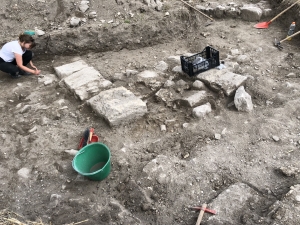
Research Travel Award Winner (Undergraduate): Summer 2018 Thanks to very generous funding I was able to work on a second century Roman bath site in Cifali, located in the province of Ragusa, Sicily. The expedition was lead by Dr. Antonino Facella, professor of archaeology at Scuola Normale Superiore in Pisa, and Dr. Alexander Evers, professor of ancient history at Loyola University Chicago's John Felice Rome Center (JFRC). I was enrolled in the JFRC's Fusion program, which serves as an introduction to the field of… read more about Katherine Owensby: Second Century Roman Bath Site in Cifali, Ragusa, Sicily, Italy »
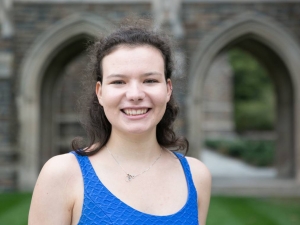
We are delighted to report that just-graduated Classical Studies student Gabi Stewart has been awarded the Chester P. Middlesworth Award — kudos plus one thousand buckeroos! - for her thesis essay, "Rostovtzeff and the Yale Diaspora: How Personalities and Communities Influenced the Development of North American Papyrology." Here's a description of the award: The Middlesworth Awards were established to encourage and recognize excellence of analysis, research and writing by Duke University students in… read more about Gabi Stewart ('18) wins Middlesworth Award »

2nd-year PhD student Sinja Küppers warmly welcomed the incoming graduate students to Duke as part of a Student Panel Discussion during the Graduate School Orientation and invited all first-generation graduate students to join Duke F1RSTS at the Graduate Student Resource Fair. read more about Classical Studies student, Sinja Küppers at the Graduate Orientation »
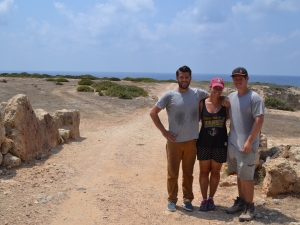
Kyle Jazwa (Visiting Lecturer) was joined by a small group of archaeologists, including Duke graduate student Antonio LoPiano, to study the architecture at Maa-Palaeokastro, Cyprus. The short-lived settlement was founded at the end of the Bronze Age and is a rare example of large-scale vernacular construction that was found undisturbed by later rebuilding. The team spent many hours in the Cypriot heat and humidity measuring stones, photographing walls, and identifying the construction methods used by the inhabitants to… read more about A Team of Duke Archaeologists Studies Late Bronze Age Architecture in Cyprus »
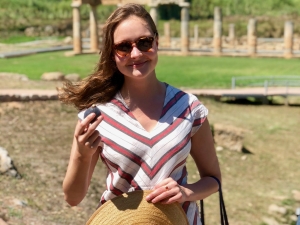
Assistant Professor Claire Catenaccio with a fig at the Temple of Artemis in Brauron, Greece - the legendary final resting place of Iphigenia - preparing to direct Euripides in an ancient theater! read more about Duke at the Temple of Artemis! »
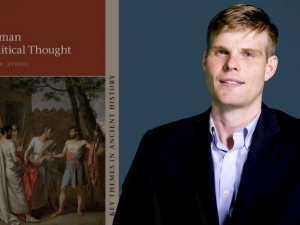
Professor Atkins discusses the content of his new book, Roman Political Thought, as part of the faculty books video series: https://youtu.be/mEmmaCnrnyU read more about Professor Jed Atkins discusses the content of Roman Political Thought »
Visiting faculty Kyle Jazwa has received a Dean’s commendation for having his course evaluations in the Spring semester fall among the top 5% of all undergraduate instructors in Trinity College. Way to go, Kyle! read more about Kyle Jazwa among top teachers in Trinity College »
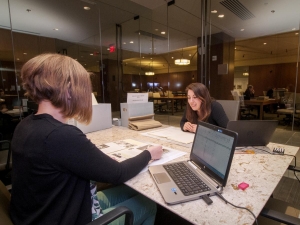
Congratulations to Michael Freeman, who has been accepted to the Rubenstein Library’s new “Archival Expeditions” program! He will work with Rubenstein archivists and CLST Professor, Clare Woods this fall and spring to develop and then teach a new archives-based Greek literature component for her History of the Book course. For more info click here. read more about Michael Freeman accepted to the Rubenstein Library’s new “Archival Expeditions” program »
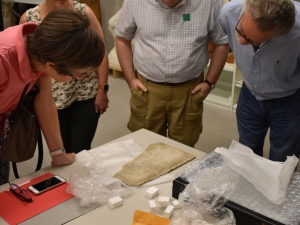
J. Francis (Duke PhD '91, Professor at University of Kentucky) last Friday (July 20) donated to the Nasher a Roman inscription (probably 4th c. and funerary) to Classical Studies, to be held in the Nasher as part of the antiquities collection. The inscription is carefully inscribed and contained interesting and unusual pictorial elements. J. Francis and Tolly Boatwright J. Francis points to an interesting feature of the inscription… read more about New Roman Inscription for the Nasher! »
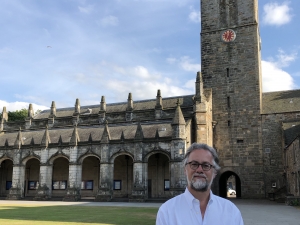
William Johnson presented an invited response paper for the panel session "Reading and Writing for Rome: literacies of administration" at The 11th Celtic Conference in Classics at St Andrews, Scotland, on the topic, "Is our goal to understand ancient reading and writing, or ancient literacy; and what’s the difference?" read more about William Johnson presents at St Andrews »

Tori Lee's abstract, " 'Tools' of the Trade: Euphemism and Dysphemism in Modern English Translations of Catullus," was accepted for the 2019 SCS annual meeting in San Diego. It will be part of the panel A Century of Translating Poetry (Organized by the Committee on the Translation of Classical Authors). read more about Abstract entitled "'Tools' of the Trade: Euphemism and Dysphemism in Modern English Translations of Catullus" was accepted for the SCS annual meeting in San Diego, CA, January 3-6, 2019 »
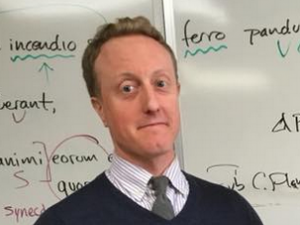
David Stifler's abstract, "Cringing at Favorinus: Lexicography and the dismantling of a legacy" has been accepted for the SCS annual meeting in San Diego, CA, January 3-6, 2019. The paper will be part of the "Literature of Empire" panel on Saturday, January 5. read more about Abstract entitled "Cringing at Favorinus: Lexicography and the dismantling of a legacy" was accepted for the SCS annual meeting in San Diego, CA, January 3-6, 2019 »
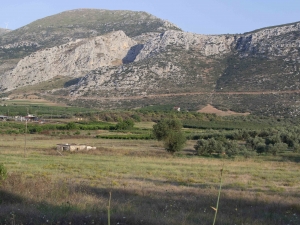
Duke CLST Visiting Lecturer, Kyle Jazwa, recently completed a two-year study of the Early Bronze Age (“EBA,” ca. 3100-2000 BCE) ceramic roofing tile assemblage from the site of Zygouries near Corinth (Greece). These tiles are among the world’s earliest and were produced at the settlement shortly after their invention in southern Greece. Although now ubiquitous in the Mediterranean, ceramic roofing tiles were relatively rare in the EBA and attest to a significant investment of labor and wealth for this highly visible… read more about Visiting Lecturer, Kyle Jazwa, Studies World’s Earliest Ceramic Roofing Tiles »
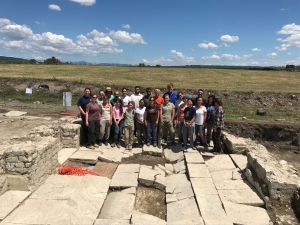
Lead by Duke Professor Maurizio Forge, the Vulci 3000, a multidisciplinary archaeological research project that employs advanced digital technologies, is focused on the Etruscan and Roman site of Vulci (10th–3rd c. BCE–4th c. CE). Located in the Province of Viterbo, Italy, Vulci was one of the largest and most important cities in the 1st millennium BCE in the Italian peninsula. This project will analyze and track the transformation and development of Vulci into a city, then city-state, and finally into a Roman city, and… read more about Professor Forte's Fieldwork Team in Vulci »