


A new program for Duke sophomores – which launches in Spring 2022 – will include two Classical Studies courses: “The Good Life: Religion, Philosophy, and Life’s Ultimate Concerns” (CLST 210) and “Medicine and Human Flourishing” (CLST 214). The two courses are part of the new “Transformative Ideas” program that is designed to promote open and civil cross-disciplinary dialogue on questions and big ideas that change lives, link cultures and shape societies around the world. “The Good Life” – taught by instructors from… read more about Classical Studies Courses Among New “Transformative Ideas” Offerings »

“It was definitely not what you sign up for when you decide to go to graduate school.” In August 2020, when many were adapting to new work patterns enforced by COVID-19, Danielle Vander Horst and more than 400 other new graduate students were beginning their journeys toward a Duke Ph.D. Their first year was unlike that of any other cohort. No welcome social. No bumping into lab mates in the hallway. No finding new restaurants in a new town. “You sign up for the department, you… read more about In 2021, the 2020 Ph.D. Cohort Finally Experienced Duke in Person »


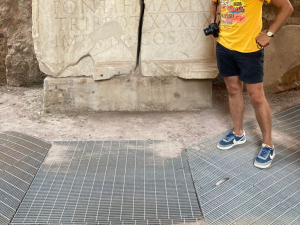
Thanks to generous funding from the department this summer, I was able to continue my participation in the Vulci 3000 Archaeological Project as a Trench Supervisor, under the supervision of Prof. Maurizio Forte. It always a thrill to be a part of such an important project and it wouldn’t be possible without the support of the department and our generous donors. Gaining excavation experience is always critical at this stage of my career and the excavations at Vulci are constantly turning up exciting new discoveries. These… read more about Antonio LoPiano: Vulci 3000 Archaeological Project »

I am indebted to the department’s generous funding which allowed me to join the Vulci 3000 Archaeological Project this summer with Professor Maurizio Forte. Never having been to Vulci before, this was an invaluable experience in adding to my professional skills in the field. Every project and site are run differently based on the research questions and methodologies in use, so having the chance to join the Vulci team and learn more about the research project itself as well as the unique combination of digital tools at the… read more about Dani Vander Horst: Vulci 3000 Archaeological Project »


Four visiting humanities scholars from historically Black colleges and universities and liberal-arts institutions arrived at Duke this August to collaborate with Duke students, faculty and staff. Their projects will cover commemoration practices, early Christian manuscripts, a 17th century Mexican philosopher and the ephemeral nature of digital projects. The fellows are part of Humanities Unbounded, an Andrew W. Mellon Foundation-funded initiative designed to nurture collaboration and inventive expressions of the… read more about Duke Welcomes New Cohort of Visiting Humanities Scholars from HBCUs and Liberal-Arts Schools »
As part of the Graduate School's Alumni Profile Series, CLST alum Theodore Graham spoke with current CLST PhD student Melissa Baroff about his career post-Duke teaching Latin at the Abraham Joshua Heschel School in New York. Read the full profile for Theodore's thoughts on his career, his advice to current PhD students, and his memories of Duke. https://gradschool.duke.edu/professional-development/blog/alumni-profiles-series-theodore-graham read more about CLST Alumnus Theodore Graham speaks about teaching high school »
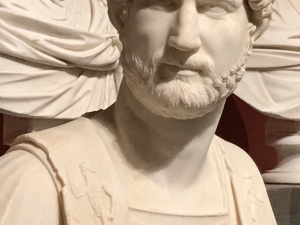
Prof Boatwright participated in a podcast on Hadrian that was aired by the Irish radio program NewsTalk Sunday, July 18, 2021. https://www.newstalk.com/podcasts/highlights-from-talking-history/hadrian-a-life read more about Podcast on Hadrian »


People in the US and abroad are buzzing about the British Museum's new exhibit: Nero - the Man behind the Myth. Our own Lauren Ginsberg sat down with Tristan Hughes of History Hit: the Ancients to talk about Nero's wives, the facts, the fiction, and the spin. Listen to the podcast episode: "Divorced, Murdered, Survived: the Wives of Nero." Professor Ginsberg also teaches a course on all things Nero - check it out next time its offered (CLST 222; HIST 241)! https://tinyurl.com/3yeku6u3 read more about Lauren Ginsberg talks to History Hit "Divorced, Murdered, Survived: The Wives of Nero" »

When he was an undergraduate political science student, Kerry Haynie was never taught about the 1921 Tulsa massacre. Nor was there much discussion about the role of race in the founding political documents of this country or much examination of how race influenced public services such as sewer lines and zoning.In one sense, a lot has changed. In 2021, Duke’s faculty includes a strong lineup of leading scholars who examine how race is embedded in issues that cross all the schools of the university. This fall, many of these… read more about University Course Raises Race as a Central Element of Undergraduate Education »

Congratulations to Duke PhD Candidate Sinja Küppers whose paper “Studying ‘Abroad' in Antiquity: Student Movement and Educational Policy” has been selected for the CAMWS Presidential Award for Outstanding Graduate Student Presentation! read more about CAMWS Presidential Award for Outstanding Graduate Student Presentation »

Editor’s note: This is one in a series of first-person essays by members of the Duke community reflecting on a year living with COVID-19. “Interrupting angels.” Who knew such things were ever imagined? In my teaching and research in the area of Jewish magic and mysticism, I’ve become acquainted with all sorts of angels. Angels of wrath and of mercy. Angels of esoteric knowledge and crafty deceit. Angels for each nation, and angels for every mood. The angel of rain, of the sea, and of destiny. I think of such… read more about Professor, Interrupted »
Dennis Keith Stanley, professor emeritus of Classical Studies at Duke, died Jan. 30. He was 86. He was the author of The Shield of Homer (Princeton University Press, 1993) a masterful interpretation of narrative sequence in the Iliad. It was nominated for the prestigious Goodwin Award of Merit of the American Philological Association (now the Society of Classical Studies). “Taking structural emphasis as a guide to poetic discourse,” said his publisher, he argued the Iliad was “not a poem of ‘might’ — as opposed to the… read more about Duke Flags Lowered: Keith Stanley, Classical Studies Professor Emeritus, Dies at Age 86 »
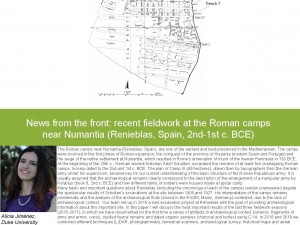
The Roman camps near Numantia (Renieblas, Spain), are one of the earliest and best-preserved in the Mediterranean. The camps were involved in the first phase of Roman expansion, the conquest of the province of Hispania (modern Spain and Portugal) and the siege of the native settlement at Numantia, which resulted in Rome’s annexation of much of the Iberian Peninsula in 133 BCE. At the beginning of the 20th c., German ancient historian Adolf Schulten, excavated the remains of at least five overlapping Roman camps, loosely… read more about Prof. Alicia Jiménez will present a virtual talk at Exeter University, UK, on the recent research finds at the camps near Numantia (Renieblas, Spain) on Feb. 11, 2021 »

As part of its event series tgiFHI, the Franklin Humanities Institute is conducting interviews with its faculty speakers in order to familiarize broader audiences with the diversity of research approaches in the humanities, arts, and interpretive social sciences at Duke University. Dr. Laura Lieber is Professor of Religious Studies, Classical Studies, German Studies, and Divinity, and director of the Duke Center for Jewish Studies. In this edited and condensed interview, she describes why she's interested in the… read more about Meet Your Humanities Faculty: Laura Lieber »

Editor’s Note: This is part of an occasional series of essays by Duke faculty members whose normal fall 2020 class routines were disrupted by the pandemic. These essays will examine how faculty adapted. When I started the fall semester, I was very worried about teaching my art history class, Virtual Museums (ARTHIST 305) — which usually has several digital lab activities — entirely online. The enrollment was high, with 20 students from five different time zones stretching from Oregon to China and Singapore. This… read more about When You View the Sistine Chapel, Where Does Your Eye Go? An Art History Class Used Digital Tools to Find Out »
Congratulations to Adrian Linden-High who successfully defended his dissertation today: "Enslaved and Freed Persons in Roman Military Communities Under the Principate (27 BCE–284 CE)” Adrian's dissertation explores the lives of persons enslaved or formerly enslaved to soldiers and veterans of the Roman imperial armies (27 BCE–284 CE). Through an innovative combination of quantitative analysis (of over 900 inscriptions) and qualitative analysis, his dissertation demonstrates how we can retrieve the complex set of choices… read more about Adrian Linden-High successfully defends dissertation! »

With an eye to studying the past, challenging the present, and contributing to a better future, the Department of Classical Studies has created an Inclusion, Diversity, Equity, and Anti-Racism Committee (IDEA). This team of graduate students and faculty is launching department-wide efforts to build an actively anti-racist community, through tough, thoughtful self-examination – from culture to curriculum, pedagogy to programming. From our diverse intellectual perspectives, we commit to taking concrete action and… read more about Department forms Inclusion, Diversity, Equity, and Anti-Racism Committee »

Research Travel Award Winner (Graduate): Summer 2019 This summer I spent six weeks in Cologne, Germany participating in the German for Classics Students summer program. The course, held at the University of Cologne, is designed for graduate students of Classics who wish to acquire a more active knowledge of German for their studies. I decided to apply for the program because I hope to read the works of the many prominent German philosophers and scholars who have written on Plato, the intended subject of my dissertation.… read more about Leo Trotz-Liboff: German for Classical Students Summer Program, Cologne Germany »

Congrats to CLST graduate students Michael Freeman and Sinja Küppers who have been accepted as "Graduate Affiliates" at Duke's new Manuscript Migration Lab, directed by our own Professor William Johnson as well as by Andy Armacost and Professor Jennifer Knust. The goal of the interdisciplinary lab is to examine the history of manuscripts held by the David M. Rubenstein Rare Book & Manuscript Library focusing, in particular, on research methodologies that relate to historical ownership and its… read more about Michael Freeman & Sinja Küppers have been accepted as "Graduate Affiliates" at Duke's new Manuscript Migration Lab »

On September 17, Professor Atkins' "Democracy: Ancient and Modern" class celebrated Constitution Day with a talk from Linda Monk, JD, on “We the Whole People: Women and Constitutional Change, from the 14th Amendment to the ERA." read more about Constitution Day »